 Instagram
 Facebook
 Mailing list
Customising a Weta Dr Grordbort Ray Gun
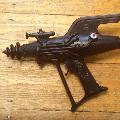
An entry for a contest run by FX company Weta. The task was to customise one of their 'Dr Grordbort Righteous Bison' ray guns, which was supplied unpainted.
Looking through Doctor Grordbort's Contrapulatronic Dingus Directory, I realised that the Grordbort style is not simply 'Steampunk'. There are Art Deco themes and elements of some fairly heavy duty machinery that look more contemporary than the usual Victorian influence. After doing numerous sketches, I felt that this would be a case where less equaled more; I wanted to avoid the trap of covering the weapon with too many unnecessary widgets and losing its form. I singled out a few key ideas and worked them into a design that I hoped would maintain the spirit of the original, despite leaving very little of it intact. There are several features on my design that echo shapes on the original but are actually entirely different structures.
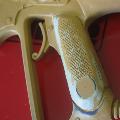
The first task was to take the rather nice raw gun and strip it to its component pieces using a heat gun and brute force. I then cut a profile for the main frame from a piece of wood and test fitted the handle and grip from the base gun.

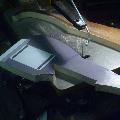
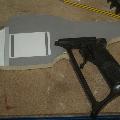
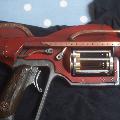
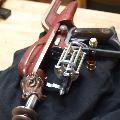
One of the key features on which I had decided was a swing-out cylinder mechanism which would contain glass vials of fluid. This needed to be built pretty solidly so I decided to make it from aluminium. I also decided to reinforce the wooden frame with metal parts so as to avoid weak points. I started by cutting out the side plates (which were intended to echo design elements in the donor gun) from 2mm aluminium. The side plates provided a strong frame to support the hinge mechanism for the cylinder. This was cut out of 10mm aluminium plate and hand-filed to shape. I made up a simple sprung bolt system that would hold the cylinder in place by pressing a domed nozzle against a depression in the base of the 'cartridge' vials, and release it when pulled back with a slider fixed to one of the plates. It took a lot of filing to make the slider!
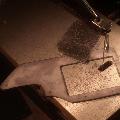
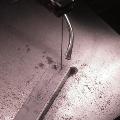
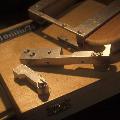
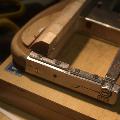
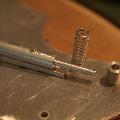
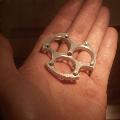
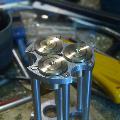
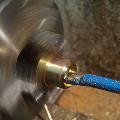
I made the ends of the cylinder from 5mm aluminium, first drilling the holes and then cutting out the shape. I then bolted each end-piece to a piece of metal stock mounted in the lathe and turned it to clean up my roughly cut edges. The support poles for the cylinder were cut to length, turned and faced on the lathe to get a nice finish, then drilled and tapped to they could be screwed into place. The middle support was made from aluminium tubing to house a spindle that screwed into the hinge mechanism.
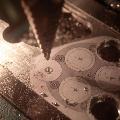
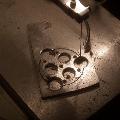
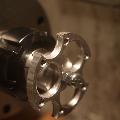
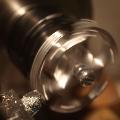
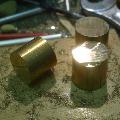
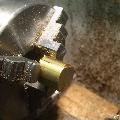
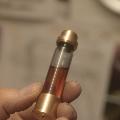
The end caps for the cartridges were made from brass rod. I turned and faced them to shape and then bored out a hole to fit a small glass vial. The vials were 'smoked' by spraying them inside with transparent lacquer. They were then filled with machine oil tinted with a different colour for each cartridge.


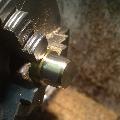
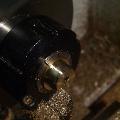
The structure to hold the barrel needed to be strong, so at its core I made an aluminium plug that friction-fit the inside of the barrel tube. I then built wooden formers around it to make the front of the gun. This allowed me to slide the barrel in and out as needed, and replace it with a length of tube clamped in a vice when I needed to hold the whole model securely. The barrel piece in the photos was a short length I used when making the formers.
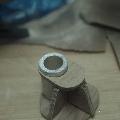
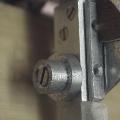
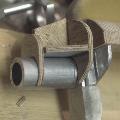
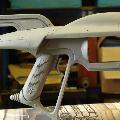
The bulk of the gun's body was made using epoxy putty sculpted over wooden formers. The formers help get the curves right when sculpting it. Once the putty is cured it is sanded and filled repeatedly until the shape is exactly right. For this project I didn't want it completely smooth as it needed to look like slightly battered metal. I used plastic mesh to make the texture that I hoped would end up looking like a well used wooden grip.
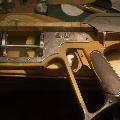
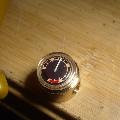
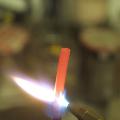
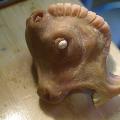
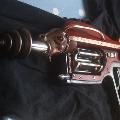
I had set myself the task of as far as possible not using 'found items' for this build, so all the detail pieces needed either to come from the original gun or to be fabricated by hand. I replaced the screw I'd been using to hold the hinge mechanism in place with a custom-turned aluminium pommel. I bent the various lengths of copper piping to shape by first heating them to red hot with a gas torch, then once they were cool enough to touch, taping the ends and filling them with sand and bending them by hand. Heating copper chemically changes it, temporarily making it softer. The sand prevented them from kinking too badly. I made the body for the pressure gauge from brass rod turned on the lathe. I designed the dial to look slightly art deco. The glass for it is in fact a found item, coming from a Pound Shop compass. I sculpted the bison head using Sculpy when I needed time to work with the modelling, and Millput where I needed it to harden without first being removed and baked in the oven.
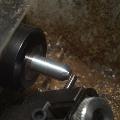
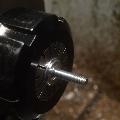
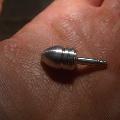
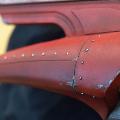
With the building complete, I scribed panel lines into the surface and drilled dozens of tiny holes into which I would later glue the pins which would represent rivets. I primed and sanded the gun and then painted the base coat with car spray paint that I decanted into my airbrush. Next I added stippled areas of texture using acrylics. I attached the detail pieces and started weathering using lacquers and ink washes. I added worn areas and scratches using a fine brush. I wanted it to look used but not abused, with the look of slightly grimy, well oiled heavy machinery.

There are more pictures of the finished piece here.

